

How to Clean LVT Flooring Without Leaving Streaks: The Maintenance Routine That Works
Stop streaky LVT floors for good. Our Peterborough fitters share the exact tools, products and routine to keep your luxury vinyl tile gleaming year-round.
Key takeaways
The short version, checked by our fitting team.
Why Does LVT Flooring Leave Streaks?
The Three Root Causes of LVT Streaks
The Tools You Actually Need to Clean LVT Properly
A Flat Microfibre Mop with a Wringing Mechanism
You've just had beautiful LVT flooring fitted in your Peterborough home — and three mops later, the floor looks worse than it did before you started. Smears across the surface. Hazy patches in the light. A thin, greasy film where you've been most diligent with the mop.
Sound familiar? You're not alone. Streaky LVT is one of the most common complaints our fitting team hears from homeowners across Peterborough, Huntingdon, Stamford and the wider Cambridgeshire area — and almost every single case comes down to the same three causes: too much water, the wrong product, or a dirty mop head.
The good news is that this is entirely fixable. In this guide, our team of professional LVT fitters breaks down exactly why LVT streaks, what tools and products you actually need, and the specific routine that keeps luxury vinyl tile looking flawless week after week.
Whether you've had LVT flooring fitted by Cambridgeshire Carpets or by another fitter in Peterborough, this guide applies equally. The principles are the same across all major LVT brands — Karndean, Amtico, Moduleo, Quick-Step, and Polyflor included.
Why Does LVT Flooring Leave Streaks?
Before we get into the routine, it's worth understanding the actual cause of the problem. LVT (luxury vinyl tile) has a wear layer at the surface — a protective coating that gives the floor its durability, scratch resistance, and that clean, finished look. This wear layer is slightly hydrophobic. It repels water.
That's a feature, not a bug. It makes LVT highly water-resistant and ideal for kitchens, bathrooms, and hallways across PE1–PE7. But it also means that if you use a soaking wet mop or leave any liquid residue on the surface, it doesn't simply dry into the floor — it dries on top of the floor, leaving a visible film.
The Three Root Causes of LVT Streaks
1. Too much water. LVT is not the same as ceramic tile. You cannot mop it the way you'd mop a stone or quarry tile floor. Any water left sitting on the surface will dry into a visible residue — especially in hard water areas like Peterborough PE1–PE4 and the Cambridgeshire fens, where dissolved minerals leave white marks behind as water evaporates.
2. The wrong cleaning product. Soap-based cleaners, oil-based wood floor products, wax finishes, and many supermarket 'floor cleaners' leave a thin residue on LVT. That residue creates the streaky, hazy appearance — and worse, it attracts dirt and makes the floor dirtier faster. Bleach and highly alkaline cleaners can also damage the wear layer over time.
3. A dirty mop head. A mop that hasn't been thoroughly cleaned between uses deposits a mix of old detergent residue, dried dirt, and bacteria onto the floor — even when you think you're cleaning. The result is a smeared, dull surface rather than a clean one.
The Tools You Actually Need to Clean LVT Properly
Forget the traditional bucket-and-string mop. It holds far too much water and it's nearly impossible to wring it out sufficiently for LVT. Here's the exact toolkit our team recommends to homeowners across Peterborough PE1 to PE7, Huntingdon PE29, and the wider Cambridgeshire area:
A Flat Microfibre Mop with a Wringing Mechanism
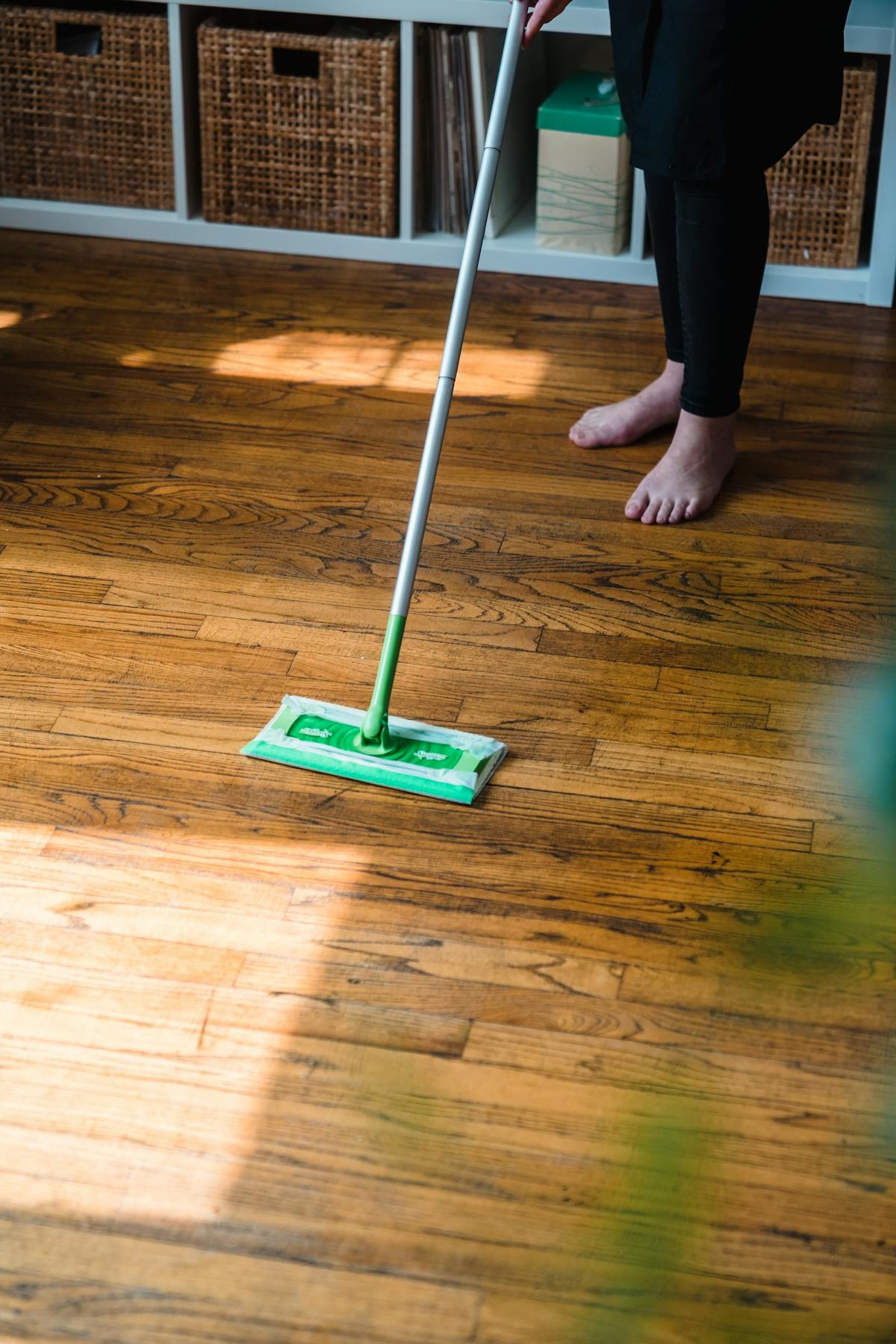
Flat mops dramatically reduce the amount of water you put on the floor compared to traditional mops. Look for one with a spray trigger or built-in sprayer head — this allows you to apply a fine mist of cleaning solution directly onto the mop pad rather than soaking it in a bucket. Brands like Vileda, Leifheit, and Bona make excellent versions at different price points. The mop pad should be damp, never wet — if you can wring liquid out of it, it has too much water.
Microfibre Cloths
Essential for spot-cleaning spills, buffing out streaks, and tackling specific areas — around the toilet base, kitchen kickboards, under furniture edges. Microfibre is gentle enough not to scratch the wear layer and absorbent enough to lift moisture quickly without spreading it around.
A Soft-Bristle Dry Brush or Microfibre Dust Mop
The single most important tool for daily LVT care. Grit, dust, and sand particles are actually far more damaging to LVT flooring than most stains — they act as an abrasive against the wear layer with every footstep. A daily dry sweep removes this before it causes damage and reduces how often you need to wet-mop, which in turn reduces the risk of streaking.
A Vacuum Cleaner with a Hard Floor Setting
If you vacuum rather than sweep, make sure the beater bar is switched off. A spinning beater bar on LVT is one of the most common causes of premature micro-scratching on the surface of the wear layer — particularly on Karndean and Amtico floors in Peterborough homes where softer wear layer grades are used in residential settings.
The Products That Work — And the Ones to Avoid
Product choice is where most homeowners go wrong with LVT maintenance. The shelf of floor cleaners in a Peterborough supermarket is full of products designed primarily for ceramic tiles, stone, or laminate — not LVT. Using the wrong one isn't just ineffective; it can permanently affect the appearance of your floor.
What to Use on LVT Flooring
pH-neutral LVT-specific cleaner (best option). Every major LVT brand produces its own cleaning solution — Karndean Floor Cleaner, Amtico Satin Refresh, Moduleo Clean — formulated specifically for the wear layer chemistry of their respective products. They clean effectively at low concentration, leave no residue, and won't affect the surface finish. A bottle lasts 6–12 months in a normal household. We stock these products and can advise on the right one for your specific floor during your free home visit in Peterborough.
Diluted white vinegar (alternative option). A solution of 1 part white vinegar to 10 parts warm water works well for general LVT cleaning and leaves no residue once dry. The mild acidity cuts through grease and hard water deposits — a particular issue in Peterborough PE1–PE7 and the Cambridgeshire fen towns where water hardness is above the national average. Note: Amtico advises against vinegar on warranty grounds — check your specific product care guide.
Plain warm water (for routine cleaning). Counterintuitively, plain warm water applied via a lightly dampened flat mop is often the most effective routine cleaner for LVT floors that are swept daily. It removes surface dust and light marks without any risk of residue buildup.
What to Never Use on LVT Flooring
Soap-based or soapy floor cleaners. Fairy Liquid, Pine Sol, Flash, and most supermarket spray mop refills leave a soapy residue that builds up with each application. The floor looks cleaner immediately after use but progressively duller over weeks — and removing the buildup requires a deep-clean session.
Steam mops. This is the most important rule: never use a steam mop on LVT under any circumstances. The high-temperature steam forces moisture and heat into the joints between planks or tiles, which causes the adhesive bond to weaken and the planks to lift at the edges. This damage voids the manufacturer warranty on virtually every major LVT brand we supply and fit in Peterborough and Cambridgeshire.
Bleach and undiluted disinfectants. While LVT is chemically resistant, regular use of undiluted bleach causes yellowing and surface degradation. For disinfecting — e.g. in a kitchen or bathroom — use a diluted solution and rinse thoroughly with plain water.
Wax or polish products. LVT doesn't need and cannot absorb wax. Applying wax, polish, or oil-based products (including many wood floor oils) creates a permanent surface coating that attracts dirt and causes exactly the streaking problem you're trying to solve. This mistake is especially common when homeowners use a product intended for engineered wood or laminate on an LVT floor in Peterborough.
Abrasive scrubbing pads. Even light abrasion scratches the wear layer, and once scratched, LVT cannot be sanded back like hardwood — the damage is permanent. For stubborn marks, use a soft cloth with targeted product, not a scourer.
The Step-by-Step Streak-Free LVT Cleaning Routine
Here's the exact maintenance routine our team recommends to every homeowner after installing LVT flooring across Peterborough and Cambridgeshire. It's designed around three tiers: daily, weekly, and monthly.
Daily Routine (2 Minutes)
Dry sweep or dust-mop all LVT areas in your home. Pay particular attention to high-traffic zones — hallways in Peterborough PE1 and PE2, kitchen floors in PE3, the area near the back door in a PE7 new build — where grit and debris accumulate fastest. This daily habit alone extends the life of your LVT significantly by removing abrasive particles before they're ground into the surface with each footstep.
Weekly Routine (10–15 Minutes)
Step 1: Dry sweep the entire floor. Before any wet cleaning, remove all loose dirt, dust, and debris. If you wet-mop over grit without sweeping first, you're dragging abrasive particles across the wear layer with every stroke.
Step 2: Fill a spray bottle with your cleaning solution. Use your chosen LVT cleaner at the dilution ratio on the label, or plain warm water. A standard trigger spray bottle — not a bucket.
Step 3: Spray lightly directly onto the mop pad or the floor section you're cleaning. The pad should be damp, not wet. If you can wring liquid from it, it has too much water.
Step 4: Mop in the direction of the planks. Work in straight strokes following the plank direction. This ensures the mop pad picks up debris from the joints rather than pushing it further in.
Step 5: Dry behind yourself as you go. In rooms where sunlight hits the floor directly — common in south-facing Peterborough living rooms — use a dry microfibre cloth or dry mop pad to immediately buff each section as you complete it. This prevents water spots, which Peterborough PE1–PE4 postcodes particularly suffer from due to high water hardness.
Step 6: Allow the floor to air dry completely before walking on it. LVT dries quickly — usually within 5–10 minutes with the correct moisture level applied. If you're seeing a sheen or haziness on the floor as it dries, you've used too much water or product and should reduce the amount next time.
Monthly Deep-Clean (30–45 Minutes)
Once a month, carry out a deeper clean to remove any product or mineral buildup that regular cleaning hasn't shifted.
For mineral and hard water deposits: Mix 1 part white vinegar to 10 parts warm water. Apply with a damp mop or cloth, leave for 2–3 minutes on the affected area, then wipe clean with plain warm water. This dissolves calcium deposits without affecting the wear layer — important in Peterborough and the wider Cambridgeshire area where hard water is prevalent.
For product residue and streaks: Apply your LVT brand's specific cleaner undiluted to a microfibre cloth and rub in the plank direction to break down the residue. For Karndean floors, Karndean's Remove product is formulated specifically for this. Rinse with plain warm water and dry immediately.
For scuff marks: A small amount of white spirit on a cloth removes most rubber scuff marks from LVT without affecting the surface. Test in an inconspicuous area first.
Room-by-Room LVT Cleaning Guide for Peterborough Homes
Different rooms present different cleaning challenges for LVT. Here's how to adapt the routine for each space in a typical Peterborough home.
Kitchen LVT (Including Open-Plan Areas)
Kitchens are the highest-traffic, highest-challenge room for LVT maintenance in Peterborough. Cooking splatter — particularly fat from frying — creates a greasy film on the floor that attracts dust and builds up over time. In the Peterborough properties we regularly fit flooring in, open-plan kitchen-diners with LVT throughout are increasingly common, particularly in Hampton PE7 and the newer developments in Stanground PE2.
For kitchens, clean spills immediately rather than letting them sit. Fat spills in particular should be wiped with a dry cloth before using any cleaner — spreading a fat spill with a wet mop creates an even larger greasy residue. After cleaning a fat-contaminated area, rinse with plain warm water to ensure no cleaning product residue remains.
Bathroom LVT
Bathrooms present a different challenge: hard water deposits from splashing and condensation, combined with soap scum from the shower. Monthly vinegar treatments handle mineral deposits well. For soap scum buildup around shower trays, apply your LVT cleaner at full concentration, leave briefly, and wipe clean. Ensure adequate ventilation — leaving a window ajar or running the extractor after bathing prevents moisture buildup at joint edges over time.
Hallway LVT
Hallways in Peterborough homes — particularly front hallways in the PE1 and PE2 Victorian terraces and the modern new-build estates in Hampton PE7 and Cardea PE2 — take the hardest punishment of any room. Outside grit, road salt in winter, and constant foot traffic make the hallway your LVT's biggest challenge.
Daily sweeping is non-negotiable for hallway LVT. Place a high-quality door mat both outside and inside the front door. Encouraging family members to remove shoes at the door reduces cleaning frequency dramatically and protects the wear layer from the abrasive grit that causes premature dulling — the primary reason LVT floors in Peterborough hallways lose their sheen faster than in other rooms.
Living Room and Open-Plan LVT
Living rooms with LVT are generally the easiest to maintain, but watch out for furniture leg scuffs. Fit felt pads to all chair and table legs before placing them on LVT — furniture dragged across the surface is a primary cause of wear layer scratches. This applies particularly to LVT in larger dining areas where heavy tables are moved for cleaning.
Caring for Specific LVT Brands Fitted in Peterborough and Cambridgeshire
We supply and fit the UK's leading LVT brands across Peterborough, Cambridgeshire, and the surrounding area. Here's a quick-reference guide for brand-specific care requirements for the products we fit most often.
Karndean LVT Care
Karndean flooring features a K-Guard+ surface treatment that provides excellent stain resistance. Karndean recommends using their own Floor Cleaner for routine maintenance, and their Remove product for stubborn marks or product buildup. Karndean explicitly advises against steam mops, wax, polish, and vinegar-based cleaners if your floor is under the manufacturer warranty.
Amtico LVT Care
Amtico Spacia and Amtico Signature floors use Amtico Satin Refresh cleaner for routine care. Amtico also recommends their Stripper product for deep-cleaning sessions and residue removal. Amtico is particularly clear that vinegar-based cleaners should not be used on their products — the acidity can affect the surface treatment over time and may affect warranty cover.
Moduleo LVT Care
Moduleo LVT is cleaned using Moduleo Clean (available from us at the time of installation) for routine use. Their warranty requires pH-neutral cleaning products and prohibits abrasives, solvent cleaners, and steam. Moduleo LVT has excellent slip resistance ratings and is particularly popular in Peterborough kitchens and hallways where safety underfoot is a priority.
Five Common Mistakes Peterborough Homeowners Make When Cleaning LVT
Having fitted hundreds of LVT floors across Cambridgeshire, these are the cleaning mistakes our team encounters most frequently:
1. Using a steam mop. By far the most common. Steam damages LVT — no exceptions, regardless of what the steam mop manufacturer claims on the packaging.
2. Not rinsing after using a cleaning product. Many homeowners clean with a floor cleaner and walk away. If any cleaner residue dries on the surface, it will streak. Always follow a cleaning pass with a plain water rinse pass if you've used product.
3. Mopping over un-swept grit. Every particle of grit left on the floor before wet-mopping is dragged across the wear layer with each mop stroke. Sweep first, every time.
4. Using washing-up liquid solution. The most common DIY floor cleaner — and the most damaging for long-term LVT appearance. It seems logical. It isn't. Soapy residue builds up fast and is stubborn to remove.
5. Over-cleaning. LVT doesn't need to be mopped every day. A daily dry sweep and a weekly damp mop is the optimal routine for most Peterborough households. Daily mopping with any solution introduces unnecessary moisture into the joints and accelerates product residue buildup.
Need Help With Your LVT Flooring in Peterborough or Cambridgeshire?
If your LVT flooring has extensive product buildup, surface scratching, persistent haze, or edge lifting that cleaning hasn't resolved, our team can help. We cover the full Peterborough and Cambridgeshire area — including Peterborough city centre PE1–PE7, Huntingdon PE29, Stamford PE9, Ely CB7, and the surrounding villages and market towns.
We offer a free home visit with flooring samples — bring the best of Karndean, Amtico, Moduleo, and Quick-Step directly to your door. If your existing LVT is beyond cleaning and you're ready for a new floor, call us today on 01733 924009 or email contact@cambridgeshirecarpets.co.uk for a free, no-obligation quote.
Need a floor fitted?
Book a free home visit — we bring samples, measure up and send a written quote within 24 hours.
Book a free home measurementFrequently Asked Questions: Cleaning LVT Flooring Without Streaks
Can I use a steam mop on LVT flooring?
No. Steam mops must never be used on LVT flooring. High-temperature steam forces moisture into the plank joints and weakens the adhesive bond, causing planks to lift and edges to peel. This voids the manufacturer warranty on virtually every LVT brand including Karndean, Amtico, and Moduleo — no exceptions.
Why is my LVT floor streaky after mopping?
Streaky LVT is almost always caused by one of three things: too much water left on the surface, a soap-based or residue-leaving cleaning product, or a mop head that wasn't clean before use. Switch to a lightly dampened flat microfibre mop with a pH-neutral LVT-specific cleaner and follow with a plain water rinse pass to prevent residue drying on the surface.
How often should I mop LVT flooring in a Peterborough home?
For most Peterborough households, a weekly damp mop is sufficient for LVT floors that are swept daily. High-traffic areas like kitchens and hallways in PE1–PE7 may benefit from twice-weekly mopping. Daily wet-mopping is not recommended — it introduces unnecessary moisture into the joints and accelerates product buildup, both of which cause streaking.
What is the best product to clean Karndean, Amtico, or Moduleo LVT?
Each brand produces its own cleaning product — Karndean Floor Cleaner, Amtico Satin Refresh, and Moduleo Clean — formulated specifically for their respective wear layers. These are the safest choice. Alternatively, a 1:10 dilution of white vinegar and warm water works well on most LVT brands (not recommended by Amtico on warranty grounds). Always avoid soap-based cleaners, wax, oil, and steam on any LVT floor.
Can I use bleach on LVT flooring?
Occasional diluted bleach can be used for disinfecting LVT, but regular use is not recommended. Undiluted bleach or frequent bleach application causes surface yellowing and wear layer degradation over time. For antibacterial cleaning in Peterborough kitchens and bathrooms, a diluted LVT cleaner or a 1:10 bleach-to-water solution with thorough rinsing is the safer approach.
My LVT floor has a persistent hazy film — how do I remove it?
A persistent hazy film is almost always product residue buildup from repeated use of soap-based cleaners. To remove it: apply your LVT brand's cleaning product at full concentration to a microfibre cloth, rub in the plank direction to break down the residue, then rinse thoroughly with plain warm water and dry immediately. You may need to repeat two or three times for heavy buildup. After clearing the residue, switch to a pH-neutral cleaner or plain water going forward.
Related guides

Don't just take our word for it.
Your new floor starts with a conversation.
Tell us what you're planning, choose a convenient time and we'll bring the flooring to you.