

How to Lay Vinyl Flooring Over Existing Tiles in a Peterborough Home
Thinking of laying vinyl flooring over your existing tiles in Peterborough? Our expert fitters explain what works, what doesn't, and how to get a perfect finish.
Key takeaways
The short version, checked by our fitting team.
Can You Lay Vinyl Flooring Over Existing Tiles in a Peterborough Home?
The Key Question: Is Your Existing Tile Floor Suitable?
What makes a tiled floor suitable for overlay?
What makes a tiled floor unsuitable?
Can You Lay Vinyl Flooring Over Existing Tiles in a Peterborough Home?
It's one of the most common questions our vinyl flooring fitters hear across Peterborough, PE1 to PE7: "Do I really need to rip up my old tiles before fitting new vinyl?" The short answer is: sometimes no — and getting it right can save you a full day of labour and significant disruption.
At Cambridgeshire Carpets, we've installed vinyl flooring over existing tiles in homes across Peterborough, Huntingdon, Ely, Stamford, and throughout Cambridgeshire. In this guide, our professional fitters walk you through exactly what's possible, what preparation is required, and when you should not lay vinyl over tiles — no matter how tempting the shortcut might seem.
If you'd prefer to leave it to the professionals, get in touch with our team or call us on 01733 924009 for a free home visit and quote.
The Key Question: Is Your Existing Tile Floor Suitable?
Not all tiled floors are created equal. Before you consider laying vinyl over the top, you need to honestly assess the condition of what's already there. Peterborough homes — particularly Victorian terraces in PE1 and PE2, 1960s and 70s builds in Dogsthorpe and Ravensthorpe, and newer developments in Hampton and Cardea — each come with their own flooring challenges.
What makes a tiled floor suitable for overlay?
- All tiles are firmly bonded — no hollow-sounding, loose, cracked, or lifting tiles
- The floor is structurally level — no more than 3mm variation across a 2-metre span
- Grout lines are not too deep — standard grout joints under 3mm wide and flush or near-flush with tile surface
- No damp or moisture issues — particularly important in bathrooms and kitchens in older Peterborough properties
- Door clearances allow for extra height — adding vinyl on top of tiles raises floor height by 2–4mm; check doors can still open freely
What makes a tiled floor unsuitable?
- Multiple cracked or hollow tiles — these will telegraph movement into the new vinyl and cause premature failure
- Old adhesive tile ridges or heavily textured tiles — unless you level with self-levelling compound first
- Deep, wide grout joints — these will show through thinner vinyl products, especially in direct light
- Damp subfloor or signs of rising moisture — vinyl over damp tiles traps the moisture and leads to adhesive failure and mould
- Height restrictions — if your floor is already at threshold level, adding more height will cause problems at doorways and transitions
What Type of Vinyl Flooring Works Best Over Tiles?
Not all vinyl flooring products are equally suited to overlay installation. Our Peterborough fitters recommend the following for tile overlay projects:
Luxury Vinyl Tile (LVT) — Click-Lock
Click-lock LVT is the most forgiving product for laying over existing tiles. Products from brands like Karndean, Amtico, and Moduleo in their floating click formats create a rigid surface that bridges minor imperfections in the tile below. The planks or tiles interlock without adhesive, meaning the floor floats above the existing surface — small undulations become less of an issue.
For tile overlay in Peterborough homes, we most often recommend Karndean's LooseLay range or click-format products from Moduleo Roots or Impress. These sit at 4–6mm thickness and have excellent acoustic and thermal properties.
Luxury Vinyl Tile (LVT) — Glue-Down
Glue-down LVT can work over tiles, but the surface preparation needs to be near-perfect. Any grout line deeper than 2mm should be filled and feathered with a flexible floor levelling compound before adhesive is applied. Brands like Amtico Signature and Karndean Da Vinci look stunning when installed this way, but require more preparation time.
Sheet Vinyl
Cushioned sheet vinyl can be laid over smooth, level tiles — particularly in bathrooms and kitchens in Peterborough PE1–PE6 homes. Its inherent flexibility makes it forgiving over slightly uneven surfaces, though pronounced grout lines will eventually show through thinner gauges. Use a minimum 2mm cushioned vinyl and fill all grout lines first for best results.
What NOT to use over tiles
Avoid cheap 1.5mm printed vinyl and very thin LVT (under 2.5mm) over unlevelled tiles. The tile pattern will telegraph through the new floor within weeks — a frustrating and costly mistake.
Step-by-Step: How to Lay Vinyl Flooring Over Existing Tiles
The following process is what our professional carpet and flooring fitters in Peterborough use on every tile overlay installation. It applies whether you're fitting in a kitchen in Orton Longueville, a bathroom in Werrington, or a hallway in a Stamford period property.
Step 1: Inspect and Tap-Test Every Tile
Start by tapping each tile with a hard object — a knuckle or a coin works well. A solid sound indicates good adhesion. A hollow or drum-like sound means the tile has debonded from the subfloor. Mark any hollow tiles with a pencil. If you find more than 10–15% of tiles are hollow, you're better off removing the floor entirely. If only a few tiles are hollow, you may be able to re-adhere them using flexible tile adhesive injected underneath, or replace individual tiles before proceeding.
Step 2: Repair Cracked or Lifting Tiles
Any cracked tiles should be repaired or replaced. In older PE1 and PE2 Peterborough properties, we often find quarry tiles or ceramic tiles that have shifted with building movement. Inject flexible adhesive under any tiles that have lifted slightly but are not cracked. Allow 24 hours to cure before proceeding.
Step 3: Level the Surface
This is the step most DIYers skip — and the reason most tile overlay installations fail. Deep grout joints and height differences between tiles must be filled before laying vinyl. Use a flexible, floor-grade self-levelling compound (not general purpose filler). Mix according to instructions, pour into the low areas, spread with a trowel, and feather to zero at the edges. Allow full cure time — usually 2–4 hours for a 3mm fill, longer for deeper fills.
For heavily grouted floors — particularly older ceramic tiles found in pre-1990 Peterborough kitchens — you may need to apply a skim coat across the entire surface to bring it to a consistent level. This is standard practice for our vinyl flooring installations in Peterborough.
Step 4: Clean and Prime
Sweep, vacuum, and damp-mop the tile surface. Remove all grease, wax, and residue. If you're using glue-down vinyl or sheet vinyl, apply a suitable floor primer to the tile surface to improve adhesive bond. Allow to dry fully — typically 30 minutes to one hour. Do not prime a click-lock floating floor, as you want the floor to float freely.
Step 5: Allow Vinyl to Acclimatise
All vinyl flooring — whether LVT, click-lock, or sheet — should acclimatise to the room temperature before installation. Leave the product flat (not rolled or stacked on edge) in the room for a minimum of 24 hours at 18–25°C. This is especially important in Peterborough homes during winter, when rooms may have been cold before heating is turned on.
Step 6: Plan Your Layout
Before fitting a single plank, plan the layout. Work from the centre of the room outward, or from the most visible wall toward a less visible alcove. In hallways and kitchens — the most common rooms for tile overlay fitting in Peterborough — run planks along the length of the room for a visually elongating effect. Avoid very thin cut strips at the walls; adjust your starting position if needed.
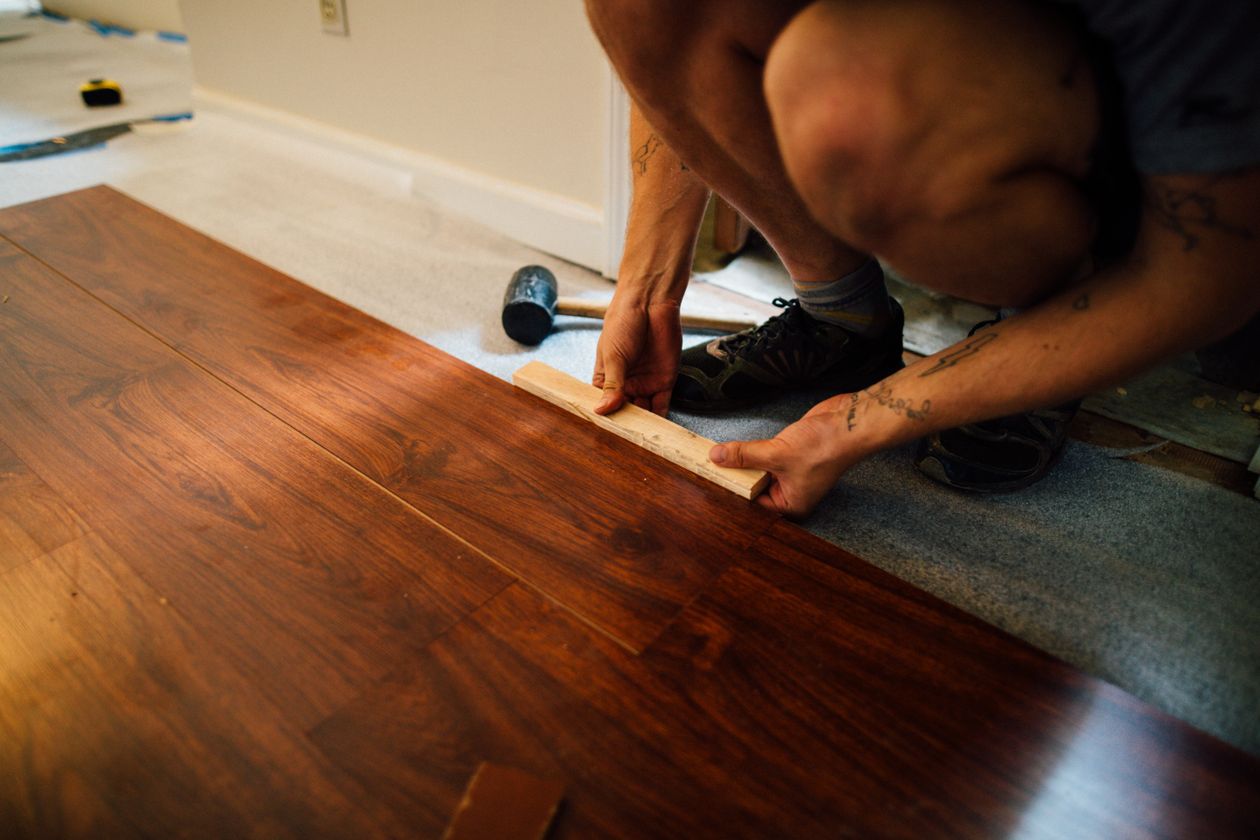
Step 7: Install the Vinyl
For click-lock LVT: Begin at your starting line and click planks together following the manufacturer's instructions. Use a pull bar and tapping block to close joints without damaging the locking edges. Stagger joints by at least one-third of a plank length from row to row. Leave a 5mm expansion gap at all walls and fixed objects.
For glue-down LVT: Apply flexible vinyl adhesive to the prepared tile surface using a notched trowel. Allow to become touch-dry (open time varies by product — typically 15–20 minutes). Lay planks from your centre line, pressing firmly and rolling with a floor roller to eliminate air bubbles. Work in sections and wipe any adhesive squeeze-out immediately with a damp cloth.
For sheet vinyl: Roll out the sheet and cut to rough size, leaving 75mm excess at each wall. Make diagonal relief cuts at corners. Gradually fold back half the sheet, apply adhesive to the tile surface, then fold the sheet back into position, pressing from the centre outward to avoid bubbles. Trim to the skirting using a sharp knife and straight edge.
Step 8: Fit Trims and Transitions
Fit floor edge trims at door thresholds and transitions to other floor types. In Peterborough homes, this is often where vinyl meets existing carpet in a hallway — use a Z-bar or T-bar trim depending on the height difference. Screw or glue to the subfloor, not to the vinyl itself.
Step 9: Final Inspection
Walk the entire floor, checking for any bubbles, loose edges, or joints that haven't closed fully. In click-lock floors, apply gentle pressure across any gaps and re-tap. In glue-down floors, check seam edges are fully bonded and add seam sealer if required.
When Should You NOT Lay Vinyl Over Tiles?
As much as overlay installation is a convenient option in the right circumstances, there are situations where our Peterborough flooring team will always recommend a full tile removal before fitting:
- Asbestos-containing tiles — any pre-1980s vinyl or composite floor tiles may contain asbestos. Never sand, cut, or disturb these. If in doubt, have the tiles tested before any work begins.
- Damp or wet subfloor — vinyl traps moisture. If there is any evidence of damp penetration or rising moisture in a Peterborough property, address the source before any flooring is laid.
- Significantly uneven tiles — if the height variation exceeds 5mm across the floor, the cost and complexity of levelling may exceed the cost of tile removal and starting fresh.
- Building Regulations compliance on floor height — in certain renovation projects, adding floor height can affect compliance with doorway and access requirements. This applies particularly in HMO properties in PE1 and PE2 where room standards are regulated.
How Much Does It Cost to Lay Vinyl Over Tiles in Peterborough?
The cost varies depending on room size, tile condition, the vinyl product chosen, and how much preparation is needed. As a rough guide for the Peterborough area (PE1–PE7):
- Preparation (levelling, priming): subfloor levelling is £5–£15 per m² where needed, depending on the area and depth of fill needed
- Click-lock LVT supply and fit: £35–£50 per m² for mid-range click-lock and rigid-core products, depending on brand and product (individual ranges, including Moduleo, are quoted at the free home visit)
- Glue-down LVT supply and fit: £50–£70+ per m² for premium glue-down Karndean and Amtico
- Sheet vinyl supply and fit: from £15 per m² (cushioned sheet vinyl £15–£25; mid-range wood- and stone-effect vinyl £25–£35; premium designer ranges £35–£45+) — see our flooring prices in Peterborough
For an accurate quote for your specific property and situation, contact our Peterborough flooring team for a free home visit and no-obligation estimate. We cover the full PE postcode area including Peterborough city centre, Hampton, Werrington, and surrounding Cambridgeshire towns.
Why Choose Cambridgeshire Carpets for Vinyl Flooring in Peterborough?
We are a Peterborough-based, independent flooring specialist — not a national chain. Our team fits vinyl flooring every week across PE1–PE7 and throughout Cambridgeshire, and we bring that accumulated local knowledge to every job:
- Free home visit with flooring samples — see the vinyl in your own light and space before you commit
- Expert subfloor assessment included — we'll tell you honestly whether overlay is viable or whether removal is the better option
- Supply and fit from leading brands: Karndean, Amtico, Moduleo, Polyflor, Quick-Step, and more
- Rated 5.0 stars across 75 Google reviews from homeowners across Peterborough and Cambridgeshire
- Company No. 15769348 — a registered, accountable local business
Ready to get started? Call us on 01733 924009 or send us a message to book your free home visit. We cover Peterborough PE1–PE7, Huntingdon PE29, Ely CB7, Stamford PE9, March PE15, Wisbech PE13, Spalding PE11, and the surrounding Cambridgeshire region.
Need a floor fitted?
Book a free home visit — we bring samples, measure up and send a written quote within 24 hours.
Book a free home measurementFrequently Asked Questions: Laying Vinyl Flooring Over Tiles in Peterborough
Can you always lay vinyl flooring over existing ceramic tiles?
No — the tiles must be firmly bonded, structurally level, and free from damp. If more than 10–15% of tiles are hollow-sounding when tapped, or if there is moisture penetration, the existing tiles should be removed before new vinyl is laid. Our Peterborough fitters carry out a full subfloor assessment as part of every free home visit.
Do grout lines show through vinyl flooring?
They can if the vinyl is thin and the grout lines are deep. Standard ceramic tiles with 3–5mm deep grout joints will telegraph through thinner vinyl (under 2.5mm) in time. The solution is to fill all grout lines with a flexible self-levelling compound before installation, or to choose a thicker click-lock LVT product (4mm+) that bridges the joints.
What is the best vinyl flooring to lay over tiles?
Click-lock LVT is the most practical option for tile overlay in Peterborough homes. Brands like Karndean LooseLay, Moduleo Roots click, and Quick-Step Livyn perform well in this application. For kitchens and bathrooms where a fully bonded floor is preferred, glue-down LVT with proper surface preparation gives the best long-term result.
How long does it take to lay vinyl over tiles in an average Peterborough home?
A standard kitchen or bathroom (10–15m²) typically takes one day — half a day for preparation (cleaning, filling, priming) and half a day for installation. Larger open-plan areas or rooms requiring extensive levelling may take two days. Our Peterborough fitting team will give you an accurate time estimate during the free home visit.
Will laying vinyl over tiles void the warranty?
This depends on the manufacturer. Many premium LVT brands — including Karndean and Amtico — permit overlay installation over a sound, prepared tile surface and will maintain their product warranty. Always check the specific product's installation guide, and ensure the preparation steps are followed precisely. Our fitters install to manufacturer specification on every job.
Can I lay vinyl over floor tiles myself, or do I need a professional?
DIY installation of click-lock LVT is possible for experienced home improvers on small, well-prepared areas. However, the subfloor preparation stage — levelling, priming, and assessing tile condition — is where most DIY tile overlay projects fail. For kitchens, bathrooms, and hallways in Peterborough homes, we always recommend professional installation to ensure the long-term performance of the product. Call us on 01733 924009 for a free quote.
Related guides

Don't just take our word for it.
Your new floor starts with a conversation.
Tell us what you're planning, choose a convenient time and we'll bring the flooring to you.