

How to Measure a Room for Carpet Fitting: Getting It Right Before You Order
Our Peterborough carpet fitters explain how to measure any room for carpet fitting — squares, L-shapes, stairs and hallways. Get your measurements right before you order.
Key takeaways
The short version, checked by our fitting team.
Why Getting Your Measurements Right Matters More Than You Think
What You Will Need Before You Start
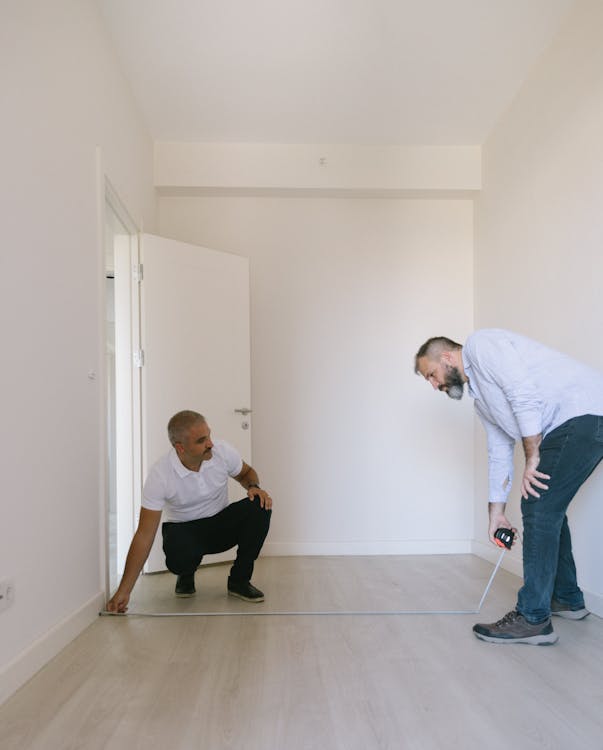
Measuring a Standard Square or Rectangular Room
Measuring an L-Shaped Room
Why Getting Your Measurements Right Matters More Than You Think
Carpet is sold in rolls, typically 4 metres wide, occasionally 5 metres. Every room is different. The challenge is not just measuring the area — it is understanding how a fixed-width roll translates into your actual room shape, where the seams will fall, and how much waste you need to budget for. Get it wrong and you risk running short of carpet, ending up with an ugly seam in the wrong place, or significantly overpaying because a poor measurement forced a wasteful cut.
At Cambridgeshire Carpets, we do a large number of free home visits across Peterborough, PE1–PE7, and the wider Cambridgeshire area specifically because we know how much difference an accurate site measurement makes. This guide walks you through the process we use on every job — so whether you are planning ahead before booking, or just want to understand what the numbers mean, you leave with a clear picture.
What You Will Need Before You Start
Measuring a room for carpet does not require specialist tools, but having the right kit makes the job quicker and more accurate:
- Steel tape measure — at least 5 metres. Fabric tape measures stretch and give inaccurate readings for large rooms. A rigid steel tape is the professional's choice.
- Notepad and pen (or your phone's notes app) — for recording measurements as you go
- Metre rule or chalk line (optional) — useful for marking reference points in open-plan rooms
- Assistant — not essential, but holding one end of the tape across a large room is much easier with two people
You do not need to move furniture to take accurate measurements — a professional fitter will always measure to the full room dimensions (wall to wall) regardless of where furniture sits, because the carpet must cover the full floor area.
Measuring a Standard Square or Rectangular Room
The simplest case. For a straightforward rectangular room in a Peterborough PE1–PE7 house or flat:
- Measure the longest wall (length) from skirting board to skirting board. Record this in metres (e.g. 4.2m).
- Measure the shortest wall (width) at right angles to the first measurement. Again, skirting to skirting (e.g. 3.6m).
- Add 100mm (10cm) to each measurement as a fitting allowance. This gives your carpet fitter room to trim accurately at the edges without running short.
- Your order size is then: (4.2 + 0.1) × (3.6 + 0.1) = 4.3m × 3.7m = 15.91m².
In practice, because carpet comes in fixed-width rolls, your fitter will typically cut to the roll width first, then trim to room size. But you still need accurate measurements to confirm whether the room can be covered from one width of roll or whether a seam will be needed.
Measuring an L-Shaped Room
L-shaped rooms are common in Peterborough's semi-detached and terraced properties, particularly where a dining area opens into a lounge, or where a hallway bends around a staircase. The key principle is to divide the room into two rectangles, measure each, and add the areas together.
For an L-shaped room:
- Identify the longest and widest points of the overall space (the bounding box).
- Divide the L into two rectangles — it does not matter where you draw the dividing line, as long as you cover the full floor area.
- Measure each rectangle (length × width), add the two areas together.
- Add 100mm fitting allowance to your longest and widest measurements when ordering.
Note: for rooms where the carpet pile runs in a specific direction (e.g. a saxony or velvet cut pile that shows shading depending on which way you walk), you need to ensure the pile direction is consistent across the full area, including the joint between the two rectangles. Your fitter will plan the cut to avoid a pile-direction conflict at the seam.
Measuring Irregular Rooms and Bay Windows
Older Peterborough properties — particularly Victorian terraces in PE1 and PE2, and Edwardian semis in areas like New England and Woodston — frequently have bay windows, chimney breast alcoves, and non-square corners. For these rooms:
- Bay windows: Measure the full width of the room at its widest point (including into the bay). Measure the room depth excluding the bay, then add the bay depth separately. Your fitter will cut around the bay or into it depending on the design.
- Chimney breast alcoves: Measure the full width of the wall the chimney is on, including the chimney breast width. The carpet runs wall to wall, with the fitter trimming around the chimney breast. You do not need to subtract the chimney breast area from your measurement — the carpet will cover the alcoves and the chimney breast surround.
- Non-square rooms: If you suspect walls are not at right angles (common in Victorian properties), measure both diagonals of the room. If the two diagonal measurements differ significantly, the room is not square, and your fitter needs to know this before cutting to avoid gaps at the corners.
Measuring for Stair Carpet
Stair carpet measurement is the most common area where DIY estimates go wrong. There are two main installation methods for stair carpets in Peterborough homes:
Waterfall fitting (most common in residential): The carpet flows over the nosing of each step and falls straight down the riser. It is easier to fit and easier to reposition later for even wear. Measure from the back of the tread (where it meets the riser) up and over the nosing and down the full height of the riser. Then multiply by the number of steps.
Hollywood fitting (bullnose/cap and band): The carpet wraps under the nosing, giving a neater finish. Requires more carpet per step (an extra 50–100mm per step) and is more complex to fit.
How to measure stairs:
- Measure the width of the stairs (between the wall and the newel post or string, if there is one). Add 50mm fitting allowance each side.
- Measure one step: tread depth (front to back, including the nosing overhang) + riser height. For a standard UK stair, this is typically 190–200mm riser and 230–250mm tread = approximately 430–450mm per step.
- Multiply by the number of steps, and add one extra step's worth of carpet for the landing join and fitting tolerance.
- Add 150mm total fitting allowance to the length.
For a standard 13-step staircase in a Peterborough PE2 three-bedroom semi, using 4m-wide carpet cut to the stair width: the order would be approximately 13 × 0.45m + 0.15m = 6.0m of carpet at the required width.
Note: if you plan to use a stair runner (a narrower strip of carpet rather than full-width fitted carpet), you will need to measure to the runner width you want, typically 600–700mm, and ensure the runner is centred on the stair tread with bare boards showing either side.
Measuring for Hallways
Hallways in Peterborough's terraced and semi-detached stock are often long and narrow, sometimes with a door threshold halfway along or a 90° turn at the bottom of the stairs. The key measurements are:
- Total hallway length from front door sill to the back wall (or to the kitchen/dining room threshold)
- Hallway width at the narrowest point (this sets your minimum carpet width)
- Any 90° turns: measure the length before and after the turn separately, then add a generous corner allowance
If the hallway turns a corner, you will need to decide whether to join the carpet at the turn (with a threshold strip) or run a single piece around the corner (which requires a larger amount of carpet but eliminates a seam). Your fitter will advise on which approach is better for the specific turn geometry.
Planning for Pile Direction and Seam Placement
Two planning decisions that affect how much carpet you need and where joins occur:
Pile direction: Cut-pile carpets (saxony, velvet, twist pile) have a directional shading effect — the pile appears lighter when you look with the grain and darker against it. For a professional result, all pieces in a room must run the same way, and the pile should typically run towards the main light source or towards the doorway. If a large room requires two or more pieces of carpet, both must be cut so the pile runs in the same direction, which can increase waste.
Seam placement: Seams should run parallel to the main light source, not across it (diagonal light on a seam makes it visible). Seams should also fall away from high-traffic areas wherever possible. Your fitter will plan seam placement during the survey visit — this is one reason why a pre-fit home visit is worth doing even if you already know the products you want.
Room-by-Room Measurement Guide for Peterborough Homes
For a typical Peterborough PE1–PE7 three-bedroom semi-detached or terraced house, here is what to measure:
- Living room: Length × width to skirting boards. If there is a bay window, measure to the back of the bay at its widest point. Typical range 15–25m².
- Dining room or dining area (open plan): Measure separately from the lounge if they are in an L or if a different product will be used. Typical range 8–15m².
- Master bedroom: Length × width. Note any built-in wardrobes — carpet should run under them if they are not yet fitted. Typical range 12–20m².
- Second and third bedrooms: Typically 8–15m² each.
- Landing: Measure the landing as a rectangle, then add the measurement for each door threshold area. Typical range 3–10m² depending on property style.
- Stairs: Use the stair measurement method above.
- Hallway: Total length × width, noting any turns or changes in width.
Common Mistakes to Avoid
- Measuring to the carpet edge, not the skirting: Always measure to the wall (skirting board face). The carpet will be trimmed to fit under the skirting, not butted against it.
- Forgetting the fitting allowance: Always add 100mm to length and width for trimming.
- Underestimating stair carpet: Stair carpet is almost always more expensive per linear metre than flat carpet because of the additional fitting time. Budget accordingly.
- Not accounting for pattern repeat: Patterned carpets require additional length to match the pattern at seams. Your fitter will calculate the repeat allowance based on the specific product you choose.
- Assuming a carpet roll is infinite: Carpet comes in fixed roll lengths, usually 15–40m per roll. Very long rooms or stairs may require a seam even if the room is only one width wide.
Why We Offer a Free Home Visit for All Carpet Measurements in Peterborough
Even with accurate measurements taken at home, a professional pre-fit survey adds significant value. Our free home visits in Peterborough and across PE1–PE7 include:
- Subfloor assessment: We check whether the subfloor (timber boards or concrete screed) is level, dry, and suitable for direct carpet installation or whether a smoothing compound or ply overlay is needed first.
- Gripper rod and underlay advice: Different subfloor types require different gripper rod fixings (nails for timber, nails or adhesive for concrete). We assess this during the survey.
- Pile direction and seam planning: We map the room and identify the best seam placement before a single piece of carpet is cut.
- Accurate written quote: We provide a full supply-and-fit quote covering carpet, underlay, gripper rods, and fitting labour — fixed price, no surprises.
To book a free home visit and measurement in Peterborough, PE1–PE7, Huntingdon, Stamford, Ely, March, or Wisbech, call us on 01733 924009 or email contact@cambridgeshirecarpets.co.uk. We are available Monday to Friday, 9am to 5pm, and aim to visit within 48 hours of your enquiry.
Related Reading from Our Peterborough Flooring Team
If this guide was useful, here are other guides from the Cambridgeshire Carpets team that might help you next:
- Subfloor Preparation for Carpet Fitting in Peterborough
- How to Choose Carpet for a Busy Peterborough Family Home
- Carpet Fitting in Peterborough — Buyer's Guide 2026
- Best Carpet Brands for Bedrooms in Peterborough
- Carpet Fitting Costs Across Cambridgeshire
- Carpet Fitting in Peterborough — our full supply and fit service page.
- Book a free home visit with carpet and flooring samples — call 01733 924009.
Frequently Asked Questions — Measuring for Carpet Fitting in Peterborough
How do I calculate how much carpet I need?
Measure the length and width of each room to the skirting boards, add 100mm fitting allowance to each measurement, then multiply length by width to get the area in square metres. For rooms requiring more than one carpet width (i.e. rooms wider than 4 metres), you will need to account for seams and pattern matching. A professional home visit will include accurate measurement, seam planning, and a fixed-price quote.
Do I need to move furniture to measure for carpet?
No. Measure wall to wall (skirting to skirting) regardless of where furniture sits. The carpet must cover the full floor area, so the room dimensions are what matter. Your fitter will move furniture on the day of fitting as part of the service.
How much extra carpet should I order for fitting?
Add 100mm (10cm) to both the length and width of each room as a trimming allowance. For rooms with bays, chimney breasts, or irregular shapes, your fitter may request a larger allowance. For patterned carpets, additional length is needed for pattern matching at seams — typically one full pattern repeat per seam.
Can I measure stairs myself?
Yes, but it is more complex than measuring a flat room. Measure the width of the stair, then measure one step (tread depth + riser height, typically 430–450mm for a standard UK stair), multiply by the number of steps, and add 150mm overall fitting allowance. A free home visit is highly recommended for stairs because pile direction, underlay specification, and gripper rod positioning all need planning before cutting.
What happens if I measure wrong and order too little carpet?
If the shortfall is small (a matter of centimetres), an experienced fitter can sometimes work with it by adjusting seam placement. If the carpet is genuinely short, you will need to order an additional piece from the same batch — and if the batch has changed, you may have a visible dye lot difference. Getting the measurement right first time avoids this entirely, which is why we always recommend a free professional survey before ordering.
Do you offer a measuring service in Peterborough?
Yes — all Cambridgeshire Carpets home visits in Peterborough and across PE1–PE7 include professional measurement as part of the free survey service. We measure every room, plan seam placement, assess the subfloor, and provide a full written quotation. To book, call 01733 924009 or email contact@cambridgeshirecarpets.co.uk.
How long does a home measuring visit take?
For a standard 3-bedroom house in Peterborough, a full measuring visit typically takes 30–45 minutes. This includes measuring every room requiring carpet, assessing the subfloor, discussing product options and pile direction, and answering any questions you have about the installation process. We also bring carpet samples to the visit so you can see and feel the options in your own lighting before committing.
Need a floor fitted?
Book a free home visit — we bring samples, measure up and send a written quote within 24 hours.
Book a free home measurementRelated guides
Don't just take our word for it.
Your new floor starts with a conversation.
Tell us what you're planning, choose a convenient time and we'll bring the flooring to you.