

Stair Nosings, Threshold Bars and Reducers: A Fitter's Guide for Peterborough Homes
Which trim goes where: nosings, door bars, T-bars and reducers explained, with the checks our fitters make at every doorway and stair edge.
Key takeaways
The short version, checked by our fitting team.
Choose the trim by the height difference: T-bar for level hard floors, reducer for a step down, door bar wherever carpet meets another floor
Carpeted stairs need no nosings; the carpet wraps the nose in a waterfall or Hollywood fit
Hard floors on stairs need a nosing fixed into the tread, either manufacturer-matched or metal
Door bars are included in our carpet prices; hard-floor trims and nosings are itemised in the written quote
The right trim depends on the height difference: a T-bar for level hard floors, a reducer where one floor sits higher, a door bar wherever carpet meets another floor, and a fixed nosing on every hard-floored stair.
Trims are the smallest part of a new floor and the part people notice most. A good one disappears under a closed door; a poor one catches toes, lifts at the ends and makes an expensive floor look unfinished. This guide sets out what each trim does, where we use it in Peterborough homes, and what we check before we fit one.
What is the difference between a nosing, a threshold bar and a reducer?
The three names cover different jobs, and fitters often use them loosely, which is where confusion starts.
- Stair nosing — a profile that caps the front edge of a stair tread (or the edge of a landing or a step down between rooms). It protects the edge, gives the eye a clear line to read the step by, and holds a hard floor down where it would otherwise chip or lift.
- Threshold bar (door bar) — a strip fixed across a doorway where two floors meet. On a carpet job it grips and protects the cut edge of the carpet; on hard floors it covers the expansion gap and the join.
- Reducer (ramp profile) — a sloped profile that steps a thicker floor down to a thinner one, so there is no trip edge between, say, laminate on underlay and a thin sheet vinyl next door.
Add the T-bar (two hard floors at the same height) and the end profile (a hard floor stopping against a patio door frame or a fireplace hearth) and you have the full family.
Which trim goes at which junction?
This is the table we work from on a home visit. The deciding questions are always the same: what are the two floors, and what is the height difference once both are down?
| Junction | Usual trim | What we watch for |
|---|---|---|
| Carpet to carpet (bedroom to landing) | Double carpet door bar | Bar centred under the closed door; both pile edges gripped, not just tucked |
| Carpet to LVT, vinyl or laminate | Single carpet bar or carpet-to-hard-floor cover strip | Carpet edge gripped so it cannot fray or walk; profile height matched to the pile |
| Hard floor to hard floor, same height | T-bar or colour-matched design strip | Expansion gap left for floating floors such as laminate |
| Thicker floor to thinner floor | Reducer (ramp) | Height difference within what the profile is made for; otherwise level the lower floor |
| Hard floor to a door frame, patio sill or hearth | End profile | Gap at the edge covered without pinning a floating floor |
| Hard floor on a stair tread or step-down | Stair nosing (manufacturer profile or metal) | Fixed into the tread, not just the floor; no overhang that flexes |
| Carpeted stairs | No nosing; carpet wraps the nose (waterfall or Hollywood) | Gripper and underlay set back so the nose stays tight |
| Public or commercial stairs | Contrasting anti-slip nosing (for example Gradus) | Visual contrast on tread and riser for safety |
Do carpeted stairs need nosings?
Usually not. On a carpeted staircase the carpet itself wraps over the front edge of each tread. In a waterfall fit it drops straight from the nose to the next tread; in a Hollywood (or bullnose) fit it is tucked tight under the nose and down the riser for a tailored look. The nose stays crisp because the gripper and underlay stop just short of the edge and the carpet is stretched over a firm, well-fixed tread.
The exception is a runner with exposed painted or timber edges, where the tread nose shows either side. Here brass or black stair rods hold the runner at the back of each tread instead. Our stair carpet in Peterborough page shows both styles, and our guide to which carpet pile lasts on stairs covers the carpet choice itself.
What nosing should I use for LVT, laminate or wood stairs?
For hard floors on stairs, the nosing does real structural work: it carries the weight of a foot landing on the front edge, which is exactly where a plank on its own would flex, crack or come loose. There are two routes.
- Manufacturer-matched nosings. Most LVT and laminate brands make a stair profile in the same decor as the floor. Quick-Step's Incizo profile, for example, is cut on site to work as a nosing, a reducer, a T-bar or an end profile. The match is close, and on a feature staircase it reads as one continuous floor.
- Metal nosings. Aluminium, brushed brass or matt black profiles with a ribbed or inset anti-slip strip. They are tougher, easier to replace and give a clear edge, which matters for anyone with poor eyesight or on a steep cottage stair.
Whichever we use, it is bonded and mechanically fixed into the tread beneath, not just to the floor covering. If you are planning hard floors on the stairs, see our LVT flooring in Peterborough and laminate flooring in Peterborough pages for the ranges we fit, and our comparison of carpet and LVT on stairs before you decide.
When is a reducer the wrong answer?
A reducer is the right tool for a small, unavoidable step between two floors. It is the wrong tool when it is used to hide a difference that should have been dealt with underneath. If a new floor in a kitchen-diner would sit noticeably higher than the hall it meets, we would rather level the lower subfloor (from £5 to £15/m² where needed) or choose a floor build-up that meets flush than fit a long, steep ramp across a doorway that people walk through all day. A ramp you notice under your foot is a trip risk, not a finish.
Where the floors are the same product, there is often no need for a bar at all. In an open-plan ground floor we run LVT through without a break wherever the product allows; our guide to room-to-room flooring flow explains how we plan that.
What do trims add to the price?
On a carpet job, door bars are already included: our carpet prices cover underlay, gripper, door bars, moving standard furniture and taking away the old carpet. On hard floors and stairs, the trims depend on the profile and finish you choose, so stair nosings, reducers, end profiles and hard-floor thresholds are itemised in the written quote, sent within 24 hours of the free home visit. Door trimming, where a new floor needs the doors taken up, is also quoted as a separate line.
| Example (supplied and fitted) | Rate | Worked figure |
|---|---|---|
| Hallway of 6 m² in mid-range click-lock LVT | £35–£50/m² | 6 × £35 = £210 to 6 × £50 = £300; reducer or threshold itemised in the quote |
| Straight flight of 13–14 steps in mid-range carpet with dense underlay | from £25 per step, typically £25–£55 | £350–£700 for the flight; carpet wraps the nose, so no nosings needed |
| Landing of 4 m² in polypropylene twist carpet | from £14/m² | 4 × £14 = £56 from; door bars to each bedroom included |
Every rate is on our flooring prices in Peterborough page.
What can go wrong at a doorway or stair edge?
Most trim problems we are asked to put right come from one of these, and each is something we check before fitting rather than after.
- Door clearance. A new floor plus underlay can raise the level enough that doors catch. We measure the gap under each door at the survey. Fire doors have gap limits set by their certification, so we will not trim one beyond what its rating allows; we flag it for a replacement door instead.
- A bar off-centre from the door. A threshold that sits visibly on one side of a closed door looks wrong from that room for ever. We set the join so the bar is hidden by the door in its closed position.
- Pinning a floating floor. Laminate and click LVT move with the seasons. Screw a trim straight through the planks and the floor buckles. Profiles go on a track or are fixed to the subfloor, leaving the floor free to move.
- Nosings on a weak tread. If a tread flexes or creaks, a hard nosing will work loose within months. We fix the tread first, or advise carpet if the staircase is not suitable for a hard floor.
- Steps of different heights. Adding a nosing and a hard floor to some treads but not others changes the rise of the first or last step. We plan the build-up so every step stays even, which is what your feet expect.
- Lead times. Matched profiles are often ordered in with the floor. We confirm they are in stock before booking the fit, so you are not left with a bare edge for a week.
Which Peterborough homes need the most thought?
In a Victorian terrace in Park or Millfield, original floorboards are rarely level from room to room, and a front hall that once had quarry tiles can sit a step lower than the back room, so reducers and careful levelling go together. The same goes for the older terraced streets nearer the city centre, where our carpet fitters in New England often meet doorways that have had three floors laid on top of each other over the years; we lift back to a sound base before fitting a bar. In a 1930s semi in Walton or Dogsthorpe, the stairs are usually solid enough for a hard-floor nosing, but the doors often need trimming once the new floor goes down. In a Hampton or Cardea new build, the screed is flat and the doors are newer, so trims are simpler, though fire doors to the hall and integral garage need checking before any trimming. And on a Fenland or Rutland cottage stair, often steep and winding, we lean towards carpet or a high-contrast metal nosing for safety.
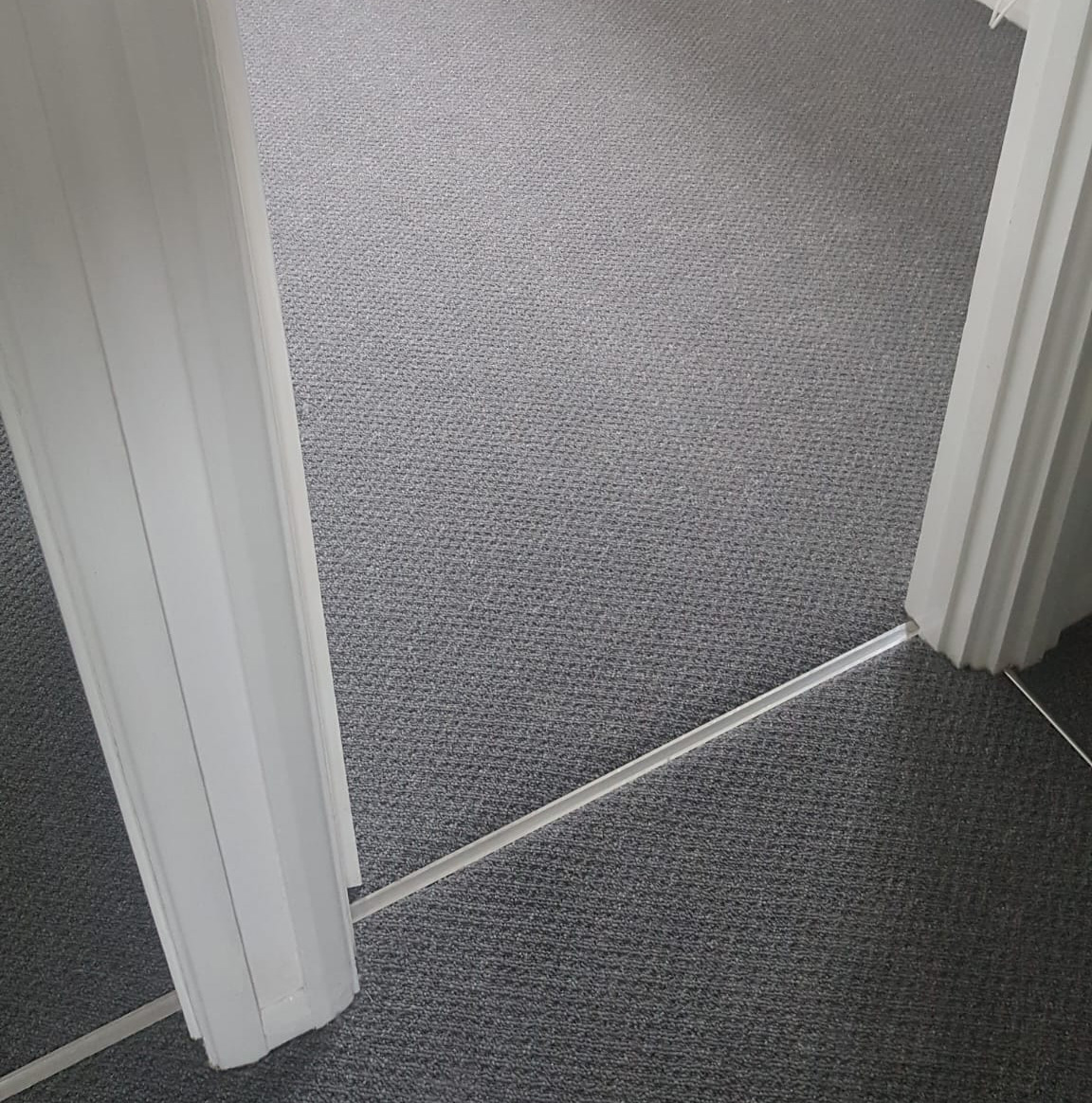
A recent fitting: the photo at the top of this guide shows a carpet-to-carpet door bar set under the line of a closed door, so neither room sees a join. More of our work is in the gallery.
Our fitters' verdict on trims and nosings
What we fit most often is simple. On carpet, a double carpet bar under the closed door, and carpet wrapped over the nose on the stairs with no nosing at all. On LVT and laminate, a manufacturer-matched profile wherever the range offers one, because it reads as part of the floor rather than an add-on. On a hard-floored staircase, a nosing fixed into the tread, never just stuck to the plank. And when a reducer would have to climb a big step, we would rather level the floor below than fit a ramp you feel every time you walk through. If a trim is going to be visible for the next fifteen years, it is worth five minutes at the survey deciding exactly where it goes.
For heavier-use stairs in offices, schools and care settings, contrasting anti-slip nosings from brands such as Gradus and Altro are part of our commercial flooring in Peterborough work.
Get the trims right first time: book a free home visit
Cambridgeshire Carpets is rated 5.0 from 75 Google reviews, with 800+ floors fitted by our own team and a 2-year workmanship guarantee. We bring samples, trims and finishes to your home, measure every doorway and step, and send a written quote within 24 hours. Call 01733 924009 to book a free home visit, Monday to Friday, or see everything we fit for flooring in Peterborough.
Need a floor fitted?
Book a free home visit — we bring samples, measure up and send a written quote within 24 hours.
Book a free home measurementAre door bars included in the price of a new carpet?
Yes. Our carpet prices include underlay, gripper, door bars, moving standard furniture and taking away the old carpet. On hard floors, thresholds, reducers and stair nosings depend on the profile and finish, so they are itemised in your written quote after the free home visit.
Do I need a threshold bar between two rooms with the same LVT?
Not always. Where the same LVT runs through and the product allows it, we fit it without a break. A bar is needed where two different floors meet, where a floating floor needs an expansion break, or where the floor changes direction at a doorway.
What is the difference between a T-bar and a reducer?
A T-bar joins two hard floors at the same height and covers the gap between them. A reducer is sloped, stepping a thicker floor down to a thinner one so there is no trip edge. If the height difference is large, levelling the lower floor is usually the better fix.
Can you fit LVT or laminate on stairs without nosings?
We do not recommend it. The front edge of a tread takes the most load, and a plank on its own can flex, chip or lift there. A matched or metal nosing, fixed into the tread itself, protects the edge and makes each step easier to see.
Will my doors need trimming after new flooring is fitted?
Sometimes. We measure the gap under every door at the survey. If the new floor and underlay would make a door catch, door trimming is quoted as a separate line. Fire doors are only trimmed within what their certification allows.
Do you fit stair nosings and threshold bars in Peterborough?
Yes. Our own fitters supply and fit door bars, reducers, end profiles and stair nosings with every floor we lay across Peterborough, the PE postcodes and Cambridgeshire. We bring trim samples to the free home visit so you can match finishes to your floor and door furniture.
Don't just take our word for it.
Your new floor starts with a conversation.
Tell us what you're planning, choose a convenient time and we'll bring the flooring to you.